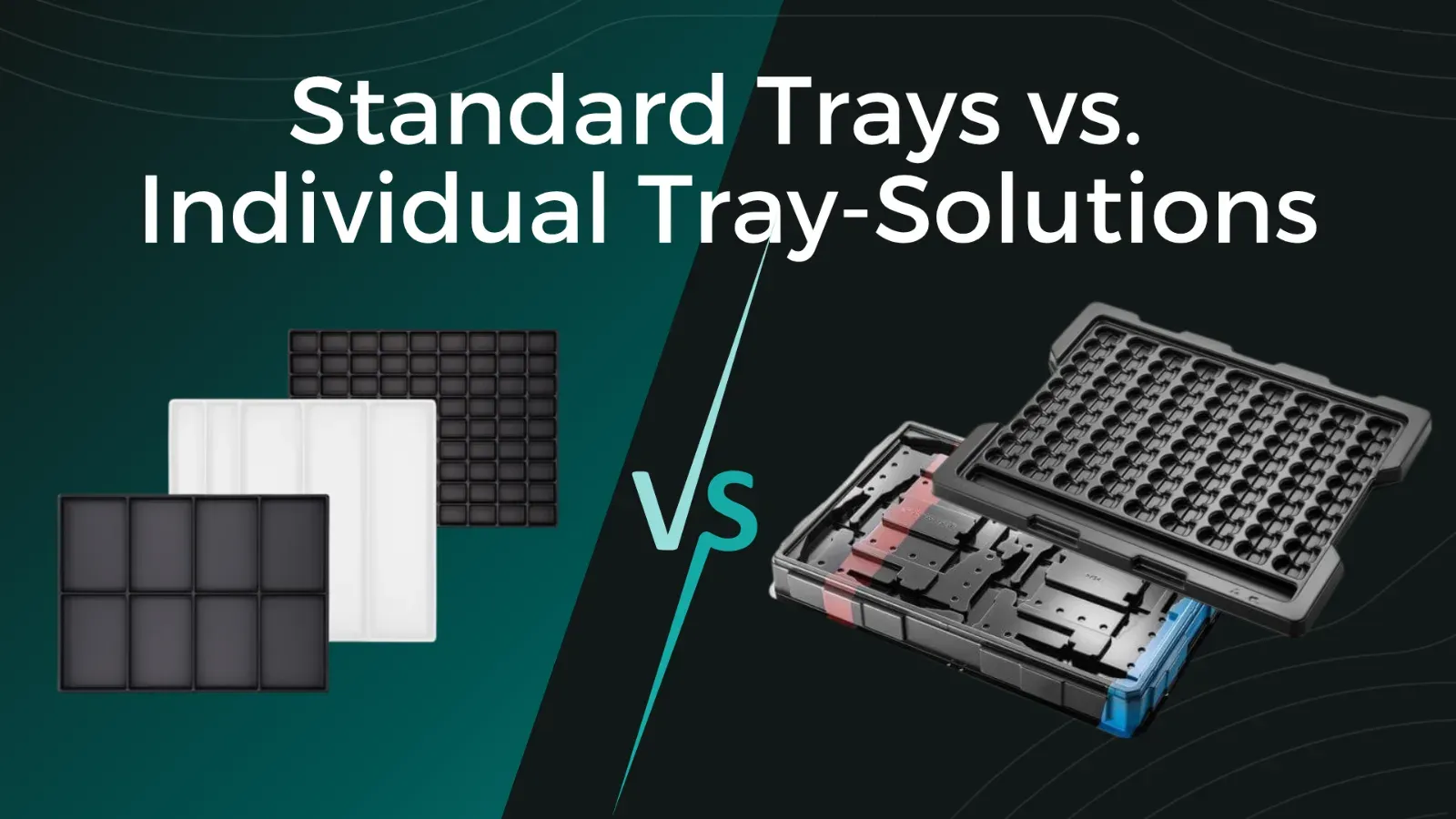
Standard Trays vs. Custom Tray Solutions: Which Option Is Best for Your Project?
Anyone sourcing plastic trays for transport, storage, or production quickly faces the question: choose a standard tray from the catalog or have a custom solution developed by a thermoforming specialist? Both options have their place. The right choice depends on the component, quantity, budget, and project requirements. This article explains which option is the right one for you.
Sarah Guaglianone
Updated on August 7, 2026
Share
Standard Trays vs. Custom Tray Solutions – The Most Important Points at a Glance
Standard trays are suitable for uncomplicated components, fast availability, and small quantities without tooling costs.
Custom tray solutions are worthwhile for exact fits, automation, series production, and special protection requirements.
The key factors are component geometry, process reliability, quantity, budget, and planned service life.
→ formary offers both options: standard thermoformed inserts in the online shop and custom-made trays via the configurator.
What Are Standard Trays?
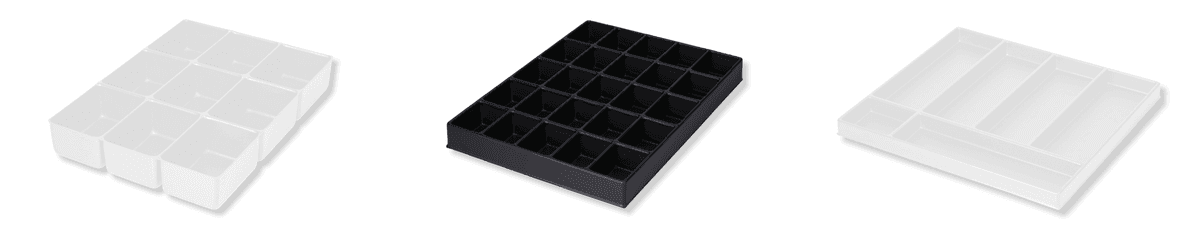
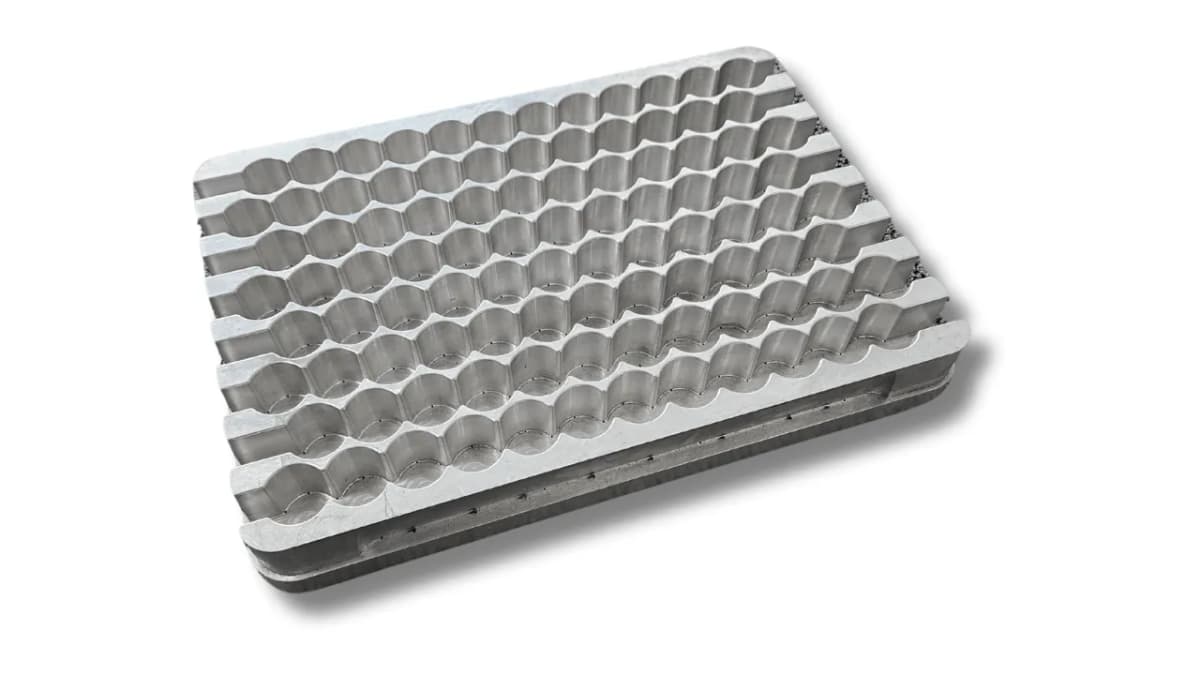
Standard trays are prefabricated plastic trays with defined outer dimensions, compartment geometries, and stacking heights. They often fit common container systems such as SLC and Euro containers.
The most important advantage: the thermoforming tool already exists. This means there are no new tooling costs, and the trays are usually available at short notice. Standard trays are often used for simple transport, storage, or sorting tasks. They are especially suitable when the component is robust and does not require exact positional fixation.
💡 Practical tip: If your component fits into an existing standard compartment and only needs to be transported or sorted internally, a standard tray is often the most economical solution.
What Are Custom Tray Solutions?
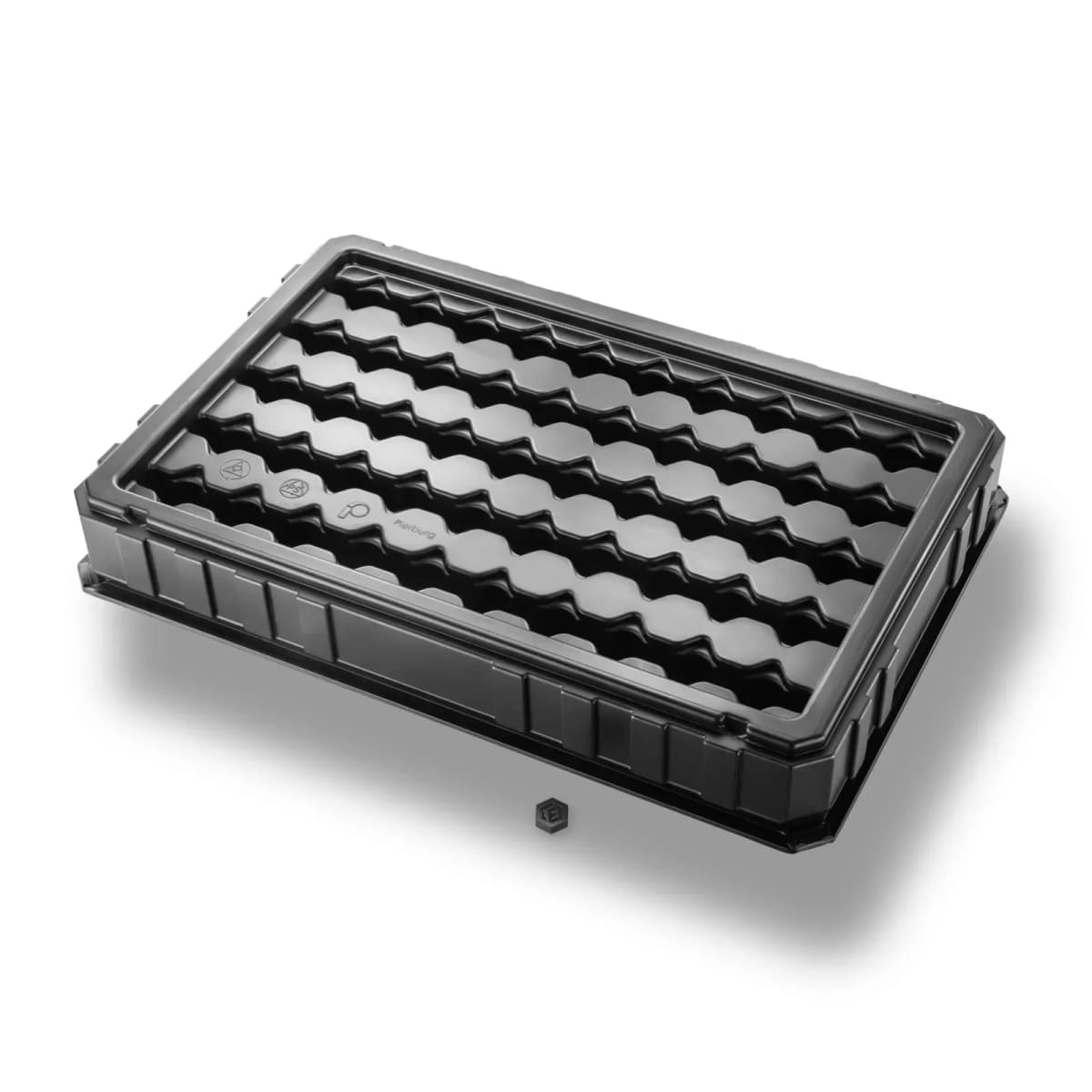
Custom tray solutions are tailor-made plastic trays or inserts that are precisely matched to the component, container system, and process. Cavities, cavity depth, support surfaces, gripping spaces, stacking stops, and material are planned specifically for the project.
Unlike standard trays, a new thermoforming tool is created for a custom solution. This results in one-time tooling costs. In return, the tray can be designed exactly for its intended application. Custom trays are often used when components are sensitive, require a defined position, or are to be handled automatically.
Decision Criteria at a Glance: Standard Tray or Custom Tray Solution?
The choice between standard trays and custom trays or inserts depends on several factors. The following table shows the most important differences:
Criterion
Standard Tray
Custom Tray Solution
Initial costs
low, no tooling costs
higher, as a tool must be created
Delivery time
usually 2–5 days
project-dependent, usually 3–6 weeks
Precision fit
limited by existing compartment geometries
exactly matched to the component
Component protection
sufficient for robust parts
high for sensitive or complex parts
Process reliability
good for simple processes
high for defined series processes
Automation
only possible if the geometry happens to fit
can be planned specifically
Material selection
limited
can be selected project-specifically
Stackability
predefined
can be planned individually
Unit costs
usually relatively constant
often decrease as quantity increases
Flexibility
low
high during the development phase
💡 In short: Standard trays solve simple tasks quickly and cost-effectively. Custom tray solutions solve specific requirements precisely and with high process reliability.
When Is a Standard Tray Sufficient?
A standard tray is sufficient when your component is robust, fits into existing compartments, and does not require exact positional fixation. In this case, fast availability and low initial costs matter more than maximum precision fit.
Typical use cases include:
Internal sorting
Storage
Order picking
Simple transport tasks
Pre-series or short-term projects
Components without sensitive surfaces
Applications without automation
Standard trays are particularly attractive when only small quantities are needed or when a quick interim solution is required. Since no new tool has to be built, procurement can begin much faster.
💡At formary, you can find standard thermoformed inserts for common container sizes directly in the online shop. These inserts are available without tooling costs and are especially suitable for fast procurement projects.
Standard Trays as an Inventory Aid
Standard trays are not only suitable for transport and storage, but also as practical support for inventory counting. Fixed compartments, defined quantities per tray, and a clear visual structure make it easier to count, inspect, and assign components.
Especially for small parts, serial parts, or recurring components, standard trays can help organize stock more clearly. Employees can see at a glance whether a compartment is occupied, whether parts are missing, or whether a defined quantity is complete.
Typical advantages during inventory counting include:
Faster counting thanks to a fixed number of compartments
Better overview of small parts
Easy separation of different components
Less searching effort in storage
Clear assignment to SLC, Eurobox, or storage location
Better preparation for picking and reordering
If components fit into an existing standard compartment, standard trays can be a simple and cost-efficient inventory aid—without new tooling costs and with fast availability.
When Is a Custom Tray Solution Worthwhile?
A custom tray solution is worthwhile when the tray must do more than just “fit” and instead secure a defined process. This is especially relevant when components are sensitive, must not shift, or must always be positioned the same way in automated workflows.
Particularly in series production, a custom solution can be more economical in the long term. Tooling costs are incurred only once, while unit costs decrease as quantities rise. In addition, a precisely fitting solution reduces risks such as damage, incorrect gripping, or inefficient handling.
💡Tip: Upload your component data to our 3D tray generator. It will generate a tray concept for you within a few seconds, which you can use directly for internal planning.
Why Do I Need a Custom Tool for a Tray or Insert?
A custom tool is necessary when a standard tray or standard insert does not hold your component securely enough. Standard parts have fixed outer dimensions, fixed compartment geometries, and predefined stacking heights. If the component does not fit these exactly, there will be play in the cavity.
This may be uncritical in simple applications. However, with sensitive components, painted surfaces, electronic components, medical parts, or automated processes, it can cause problems.
Possible consequences include:
Components shifting inside the tray
Surfaces getting scratched
Parts not lying in a clearly defined orientation
Robots or grippers picking incorrectly
Stacks not being guided safely
Transport and storage becoming less process-reliable
With a custom thermoforming tool, cavities, support surfaces, cavity depth, wall angles, gripping spaces, and stacking stops are specifically adapted to your component. This results in one-time tooling costs, but gives you a solution that exactly matches the component, process, and quantity.
💡In short: A custom tool is worthwhile when a standard part cannot reliably meet the requirements for fit, component protection, or process reliability.
Costs: Standard Tray vs. Custom Tray Solution
Total costs consist of tooling costs, unit costs, material, complexity, and project duration. Standard trays involve no new tooling costs. However, shape, compartment geometry, and material selection are predefined. Custom tray solutions involve one-time tooling costs, but can offer lower unit costs and higher process reliability for medium to large quantities.
Note: The following figures are general rules of thumb. Depending on complexity, size, quantity, etc., there may be deviations.
Example Costs for a Standard Tray:
Tooling costs: €0
Unit price: €5–15 (depending on size and material)
Available from stock
Example Costs for a Custom Tray Solution:
Tooling costs: €2,000–8,000 (depending on complexity)
Unit price in series production: €3–10 (decreases as quantity increases)
Project lead time: 3–6 weeks
💡Rule of thumb: For small quantities under 100 units, a standard tray is often cheaper. From around 200–500 units, a comparison becomes worthwhile. For larger series, custom tooling costs can be amortized through lower unit costs, better component protection, and more stable processes.
Availability and Delivery Time
Standard trays are usually available from stock and can be delivered within a few days. This makes them ideal for urgent projects, pre-series runs, or fast procurement without long lead times.
Custom tray solutions require more development time. This includes:
Project lead time is usually 3–6 weeks, depending on the complexity of the tray.
Comparison of Availability for Standard and Custom Solutions
Tray Type
Delivery Time
Advance Planning Required?
Standard tray
2–5 days
no
Custom solution
3–6 weeks
yes (design, toolmaking)
Precision Fit and Process Reliability of Custom Trays and Standard Parts
Precision fit is one of the most important differences between standard trays and custom tray solutions. With standard trays, the component has to fit into an existing compartment geometry. This may be sufficient if the component is robust and some movement in the compartment is not a problem. However, with sensitive parts, this play can lead to scratches, pressure marks, or unstable positioning.
Custom tray solutions, by contrast, are developed directly around the component. This makes it possible to design cavities, support points, and cavity depths so that the component lies securely and is protected.
Precision fit in comparison
Standard tray: Component fits “approximately,” with some play
Custom solution: Component sits in a form-fitting cavity, with a defined position
If your process is automated or requires high repeat accuracy, the custom solution is almost always the better choice. For manual sorting or simple storage processes, the standard solution is often sufficient.
Material Selection and Special Requirements
Standard trays are usually offered in common materials and colors. Depending on the product range, ESD variants may also be available. However, the selection remains limited to existing versions.
💡Tip: In addition to regular standard trays and inserts, our online shop also offers numerous black ESD inserts made of PS.
Custom tray solutions offer full material flexibility. You can choose between all common thermoplastics: PP,PS,ABS,PC,PET-A,PET-G,PMMA, or compounds. This also makes ESD protection, cleanroom suitability, special wall thicknesses, or surface treatments possible.
Comparison of Material Selection for Standard Trays and Custom Tray Solutions
Tray Type
Material Selection
ESD, Cleanroom?
Standard tray
limited (PP, PS, PET-G)
partially available
Custom solution
fully configurable
yes, can be planned
💡Practical tip: If ESD protection, cleanroom certification, or special mechanical properties are required, there is usually no way around a custom solution. You can easily enter specific requirements in our configurator.
Automation and Robot Handling
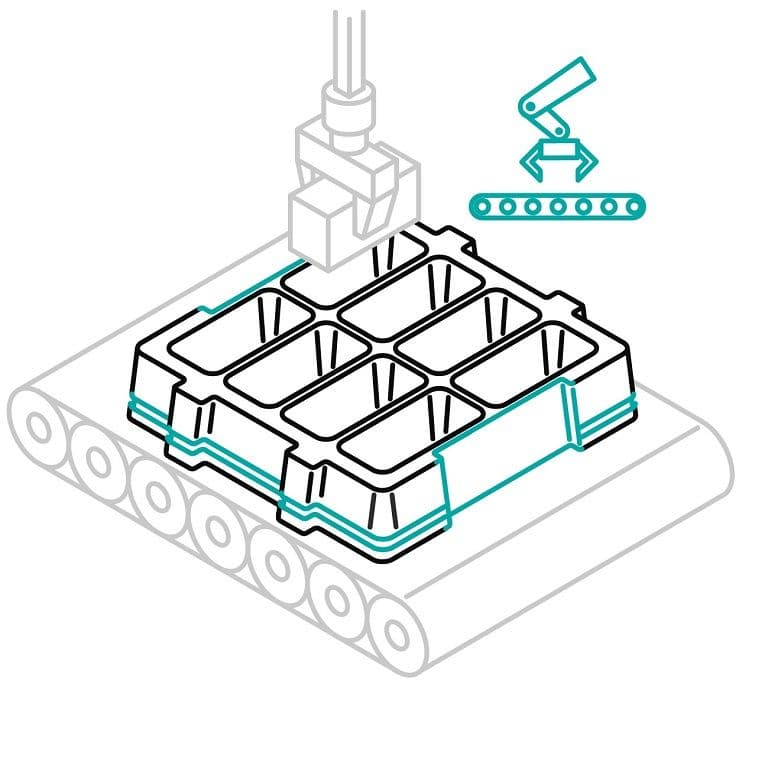
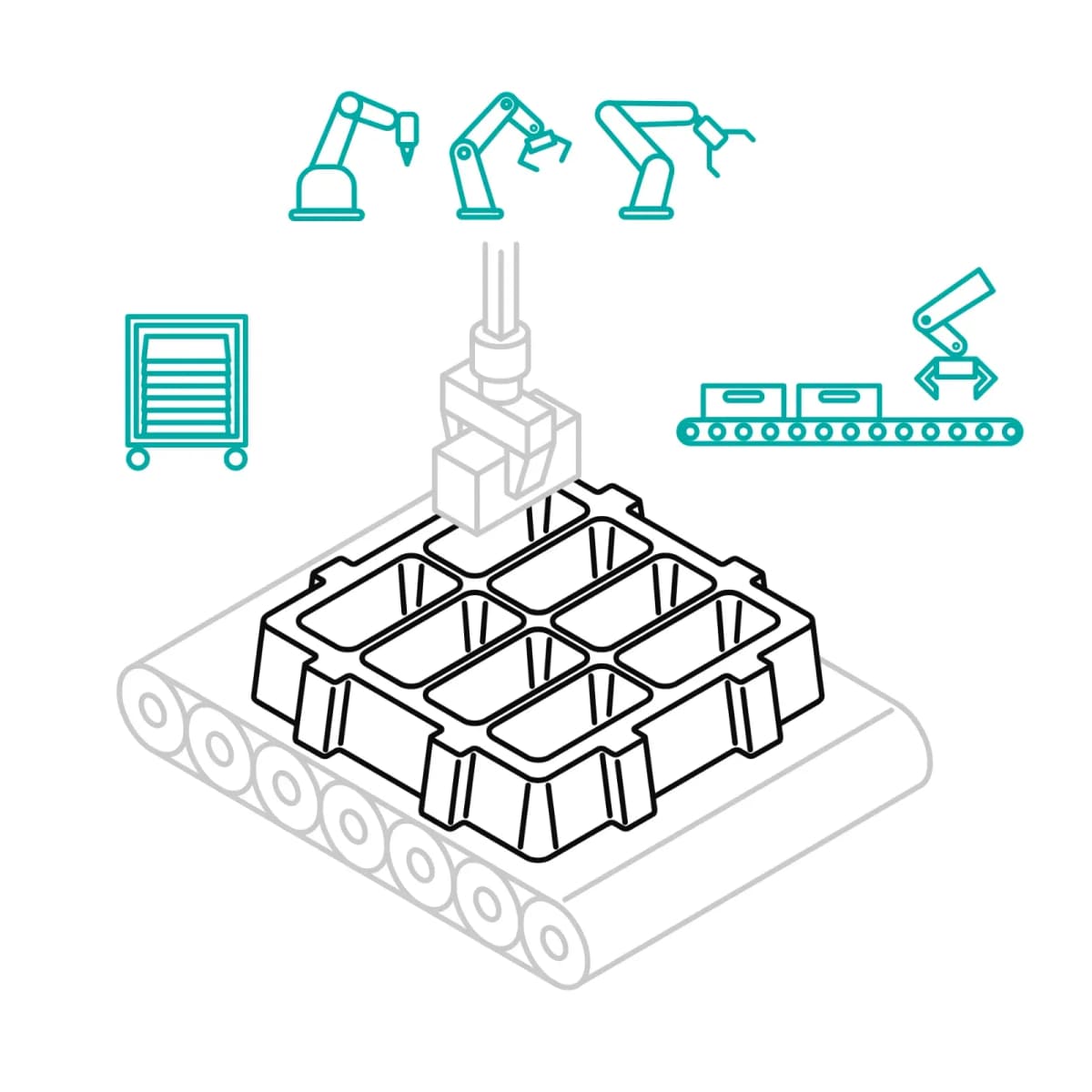
For manual processes, a standard tray is often sufficient. As soon as trays are used in automated systems, the requirements increase significantly. Robots and grippers need defined component positions, reproducible distances, and sufficient gripping space. With a standard tray, this is only possible if the existing geometry happens to match the component and the gripping system.
Custom tray solutions, on the other hand, can be designed for automation from the very beginning. This includes:
Defined component orientation
Gripping spaces for robots
Consistent cavity positions
Stacking stops
Alignment aids
Poka-yoke features
Stable tray geometry for repeatable processes
In short: If automation is planned, a custom solution is in many cases the better choice.
Small Series or Large Series: Which Solution Fits the Quantity?
For small quantities under 100 units, standard trays are usually more economical. The lack of tooling costs has a direct impact on total costs. Standard solutions also often remain the first choice for pre-series runs, prototypes, or short-term projects.
From medium series onward (200–500 units), a custom solution often becomes worthwhile. The tooling costs are spread across more parts, and unit costs decrease. For large series (>1,000 units), the custom solution is almost always cheaper and offers better process reliability.
Quantity Comparison of Standard Trays and Custom Trays
Quantity
Recommendation
< 100 units
Standard tray usually cheaper
100–500 units
Comparison worthwhile
> 500 units
Custom solution usually cheaper
These values are guidelines. What matters is not only the quantity, but also the risk: if a damaged component is expensive or process errors cause high follow-up costs, a custom solution can also be worthwhile for smaller quantities.
Stackability and Storage Efficiency
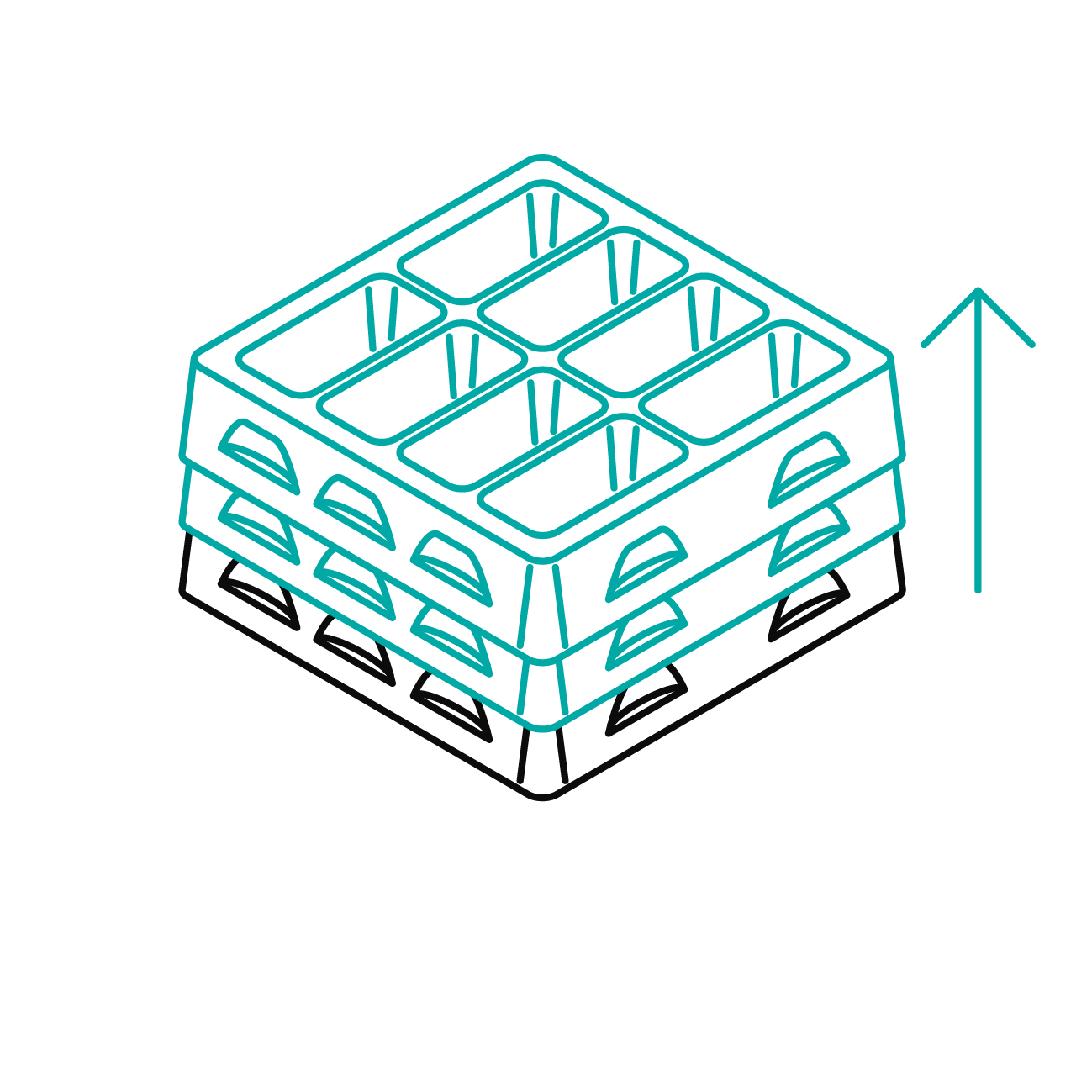
Standard trays are often stackable, but stacking heights are predefined. If your storage system has special requirements, this can be problematic.
With custom tray solutions, stackability can be developed specifically. This is particularly relevant when many trays are in circulation or when containers, shelves, and transport carts need to be used optimally.
The following can be planned, for example:
Defined stacking heights
Secure stacking stops
Nestable/reversible stacking
Space-saving empty trays
Stack security
Adaptation to SLC, Eurobox, or special containers
If storage space is expensive or many trays are in permanent use, optimized stackability can significantly improve cost-effectiveness.
Decision Guide: Which Tray Solution Fits Your Project?
The following checklist helps with the selection:
A standard tray is probably sufficient if:
The component is robust
The component fits into an existing compartment
No exact positional fixation is required
The quantity is small
The solution must be available quickly
Tooling costs should be avoided
No automation is planned
A custom tray solution is probably advisable if:
The component is sensitive or complex
Surfaces must be protected
A defined component orientation is required
Automation or robot handling is planned
ESD protection, cleanroom suitability, or special materials are required
Stackability should be specifically designed
Medium to large series are planned
💡Tip: If several points from the second list apply, a custom tray solution should be evaluated from both a technical and economic perspective.
Hybrid Approach: Standard Tray as an Interim Solution
In some projects, time is short, but a custom solution makes more sense in the long term. In that case, a standard tray can serve as an interim solution.
How the Hybrid Approach Works:
Order the standard tray immediately (production can start)
Develop the custom solution in parallel (design, toolmaking)
Switch to the custom solution after 3–6 weeks
This ensures operational readiness while enabling long-term optimization at the same time. This approach is especially useful during production ramp-ups or urgent projects.
What Data Is Needed for an Inquiry?
The better the data available, the faster a suitable solution can be evaluated.
For standard trays, the following is usually required:
Container dimensions, e.g. SLC or Eurobox
Desired number of compartments or compartment size
For custom tray solutions, the following is usually required:
Component geometry, e.g. CAD data, drawing, or photo
Outer dimensions of the tray or container system
Number of compartments or desired packing density
Material requirements
Planned quantity
Intended use: transport, storage, assembly, or automation
Special requirements such as stackability, gripping spaces, color, labeling, or ESD protection
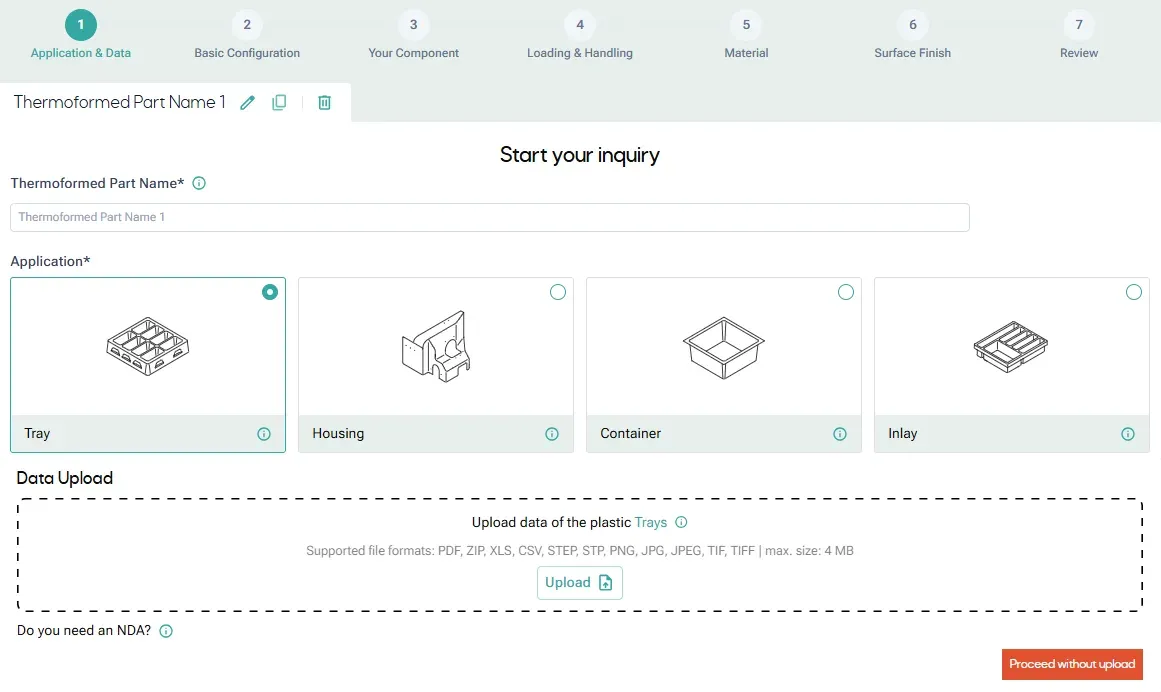
The more complete your information, the faster you will receive a suitable quotation. Our configurator guides you step by step through the inquiry process.
formary also supports you when data is missing through technical consultation, and if CAD data for your tray already exists, it can be analyzed for thermoformability using the automated DfM analysis.
Conclusion: Standard Tray or Custom Tray Solution?
Standard trays and custom tray solutions are not competing options, but answers to different requirements. Standard trays stand out for fast availability and low initial costs. Custom solutions offer precision fit, process reliability, and long-term cost-effectiveness.
The deciding factors are component geometry, quantity, process requirements, and budget. If you are unsure which solution fits, have your project reviewed technically. formary offers both paths: standard thermoformed inserts in the online shop and custom-made trays via the configurator or the 3D tray generator.
A custom tool is necessary when a standard tray or standard insert does not hold your component securely enough. Standard parts have fixed outer dimensions, compartment geometries, and stacking heights. If your component is sensitive, complex in shape, or intended for a defined process, too much play in the compartment can lead to shifting, scratches, misgrips, or unstable stacking.
With a custom thermoforming tool, cavities, cavity depth, support surfaces, gripping spaces, stacking stops, and material are specifically adapted to your component and your process. This involves one-time tooling costs, but gives you a precisely fitting tray or insert with higher process reliability, better component protection, and often lower unit costs in series production.
Standard trays are prefabricated plastic trays with defined cavities that are available from stock. Custom tray solutions are tailor-made and precisely matched to the component, process, and container system. Standard trays do not involve tooling costs, while custom solutions offer exact fits and decreasing unit costs in series production.
A custom thermoformed tray is worthwhile when sensitive components need protection, automation is planned, medium to large series are produced, or special requirements such as ESD protection, cleanroom suitability, or exact stackability exist. From around 200–500 units, tooling costs are often amortized through lower unit costs and higher process reliability.
For a custom tray inquiry, formary requires component geometry (CAD data, drawing, or photo), the outer dimensions of the tray or container system, the number of compartments, material or requirements such as ESD protection, the planned quantity, intended use, and special requirements such as stackability or gripping spaces. The more complete the information, the faster a suitable quotation can be prepared.
Important cost factors are tooling costs (for custom solutions), unit costs (which decrease in series production for custom solutions and remain constant for standard trays), quantity, material, complexity, and post-processing. Standard trays have no tooling costs but higher unit prices. Custom solutions require tooling costs but offer lower unit costs from medium series onward.
Standard trays are available from stock and can be delivered within 2–5 days. They are suitable for urgent projects, pre-series runs, or quick procurement without long lead times. Custom tray solutions require 3–6 weeks of development time for technical review, design, toolmaking, and sampling.
Standard trays make inventory counting easier because components are placed in fixed compartments. This makes it easier to record quantities, identify missing parts, and organize small parts more clearly. Especially for recurring components, KLT inserts, or warehouse processes, standard trays can simplify stocktaking and reduce counting effort.
Further Content
Thermoformed Parts in Practice
Supplier Guide for Plastic Thermoformed Parts – 10 Key Factors That Matter
Choosing the right supplier for plastic thermoformed parts is crucial for the quality, efficiency, and cost-effectiveness of your production. Our 10 tips will show you what to look for when selecting a supplier.
Platform & Features
3 Factors That Accelerate Your Procurement with formary
The three key factors—time, speed, and efficiency—are crucial for success in industrial manufacturing, from inquiry to delivery. That’s why formary has optimized this process, significantly accelerating the procurement of plastic thermoformed parts. Learn more in this article.
Thermoformed Parts in Practice
Rapid Prototyping in Thermoforming – Definition, Benefits & Processes
Rapid prototyping is used in product development to quickly create preliminary models. In thermoforming, rapid prototyping offers numerous advantages for producing high-quality prototypes efficiently and cost-effectively.
Platform & Features
Project Planning in Thermoforming – From Concept to Mass Production
From the initial idea to mass production, various factors must be considered in thermoforming project planning, including material selection, tool manufacturing, and quality control. This article provides a detailed look at how a thermoforming project with formary is executed.
Thermoformed Parts in Practice
Thermoforming vs. 3D Printing – Advantages, Disadvantages, Differences, and Similarities
Plastic parts are manufactured using various processing methods. In this article, we focus on comparing the processes of plastic thermoforming and 3D printing.
Thermoformed Parts in Practice
Injection Molding vs. Plastic Thermoforming – Advantages, Disadvantages, Differences, and Similarities
In the world of plastic processing, there are various common manufacturing methods used to produce precise plastic components for industrial applications. We compare two of them: Injection Molding and Plastic Thermoforming.
Thermoformed Parts in Practice
Checking CAD Models for Thermoformability: The Designer's Guide
Whether a plastic part is thermoformable is determined in the CAD model. Anyone who discusses geometry, wall thicknesses, and demoldability only after the first sampling pays for this loop with tool modifications, material waste, and lost weeks in the project timeline. This can be avoided during design: with a structured check that evaluates each model along this guide and makes typical sources of error visible early on.
Thermoformed Parts in Practice
Design for Manufacturing (DfM): Guide to Manufacturing-Oriented Design
With the new Design for Manufacturing analysis from formary, it is now possible to check CAD data for thermoformability in a matter of seconds, allowing potential sources of error to be identified early on before they become costly. Read on to find out what features the DfM software offers and what the Design for Manufacturing principle entails.
Thermoformed Parts in Practice
Unit Costs and Tooling Costs in Thermoforming: Cost Factors and Scalability
The costs in plastic thermoforming are a crucial factor for the economic efficiency and planning of a project. They depend on various influences along the process chain and change depending on production volume and requirements. This article explains how costs in plastic thermoforming are composed, how they develop with increasing quantities and when the process becomes particularly worthwhile.