Tray Labeling: How to Use Labels Effectively for Your Packaging
To ensure that trays can be correctly identified and used, clear labeling is essential. Depending on the application, quantity, and process requirements, different methods can be used, such as permanent engraving or flexible labels. In this article, you will learn which tray labeling methods are available, when each method makes sense, and how labeling can already be incorporated into the tray design using formary’s 3D Tray Generator.
Simon Andreß
Updated on September 25, 2026
Share
Tray Labeling – Key Facts at a Glance
Tray labels enable the clear identification, traceability, inventory management, and automation of plastic trays.
Methods such as engraving, embossing, hot stamping, color strips, or labels are suitable for different applications depending on the material, quantity, and intended use.
Engravings provide the most durable solution because they are resistant to cleaning, tamper-resistant, and ideal for ESD or cleanroom applications.
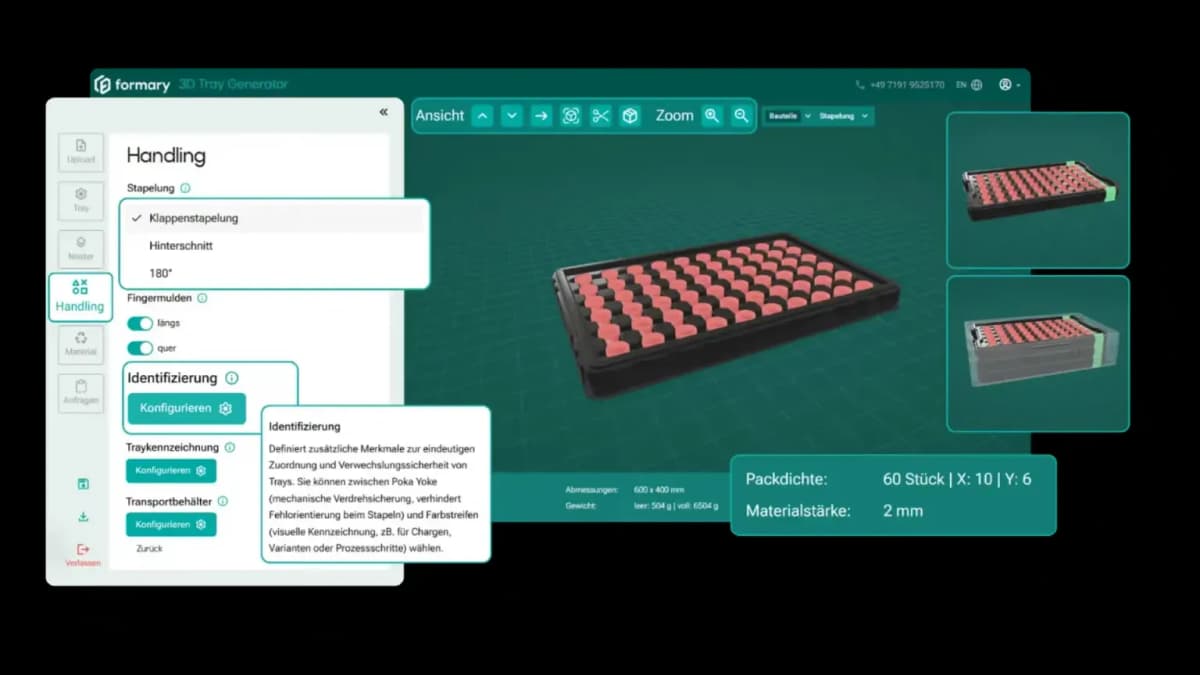
With the 3D Tray Generator from formary, labeling can be taken into account at an early stage of the tray design and checked for technical feasibility.
Tray labeling is a unique inscription or marking applied to plastic trays. Among other things, it enables:
Identification
Traceability
and automation.
Depending on the requirements, different methods are used: from permanent engravings that are incorporated directly into the thermoforming tool and transferred to the tray during plastic thermoforming, to flexible labels or colored strips.
Engraved markings are particularly suitable for reusable trays, ESD-protected workpiece carriers, automation trays, and applications with high requirements for cleaning resistance and reliable operation. Other methods, such as labels or color strips, are often sufficient and more cost-effective when requirements are lower.
💡 In addition, formary also offers printing for plastic trays, which is particularly suitable for logos, lettering, symbols, scales, or other visual markings. However, this article focuses primarily on tray labeling by means of engraving.
When Is Which Tray Labeling Method Worthwhile?
Not every application requires permanent engraving. The choice of the appropriate method depends on the operating conditions, quantity, and process requirements of the project.
Permanent labeling such as engraving is worthwhile when:
trays are frequently cleaned or disinfected
there is a high level of mechanical stress
traceability must be ensured over several years
trays are automatically identified, sorted, or transported
labels would otherwise detach due to temperature, chemicals, or abrasion
Simpler methods such as labels or color strips are sufficient when:
trays are only used temporarily or internally
quantities are low
there is no cleaning or mechanical stress
identification is purely visual and does not involve automation
💡 If trays are used in automated processes, barcodes or QR codes should be positioned so that they can be reliably detected by scanners or camera systems. Early coordination with the automation engineering team helps prevent later modifications.
What Methods Are Available for Tray Labeling?
Depending on the material, quantity, budget, and area of application, various labeling methods can be considered.
Tray labeling method
How it works
Advantages
Disadvantages
Suitable for
Laser engraving
Material removal or color change caused by a laser beam
permanent, contactless, precise, no tooling required
investment for large series, material-dependent
series production, barcodes, fine lettering
Embossing
Mechanical pressure creates an indentation
cost-effective for large series, very robust
tooling costs, limited level of detail
large series, simple lettering/logos
Hot stamping
Hot foil is pressed into the material
high contrast, easy to read
less durable than engraving
medium-sized series, high readability
Color strips
Colored plastic layer
simple, cost-effective
no alphanumeric information
sorting, visual differentiation
Labels
A label is applied
flexible, can be added later
may detach
single-use applications, low stress
For applications with high requirements for durability and process reliability, laser engraving is particularly common because it is flexible, precise, and permanent. It is suitable for plastics such as ABS, PC, PET-G, PP, or PS, and produces clearly legible codes, text, or logos without contact with the component.
What Information Can Be Engraved on Trays?
The type of labeling depends on the intended application. Typical content includes:
Identification Data
Serial numbers, part IDs, project numbers, or customer identifiers enable unique assignment and traceability.
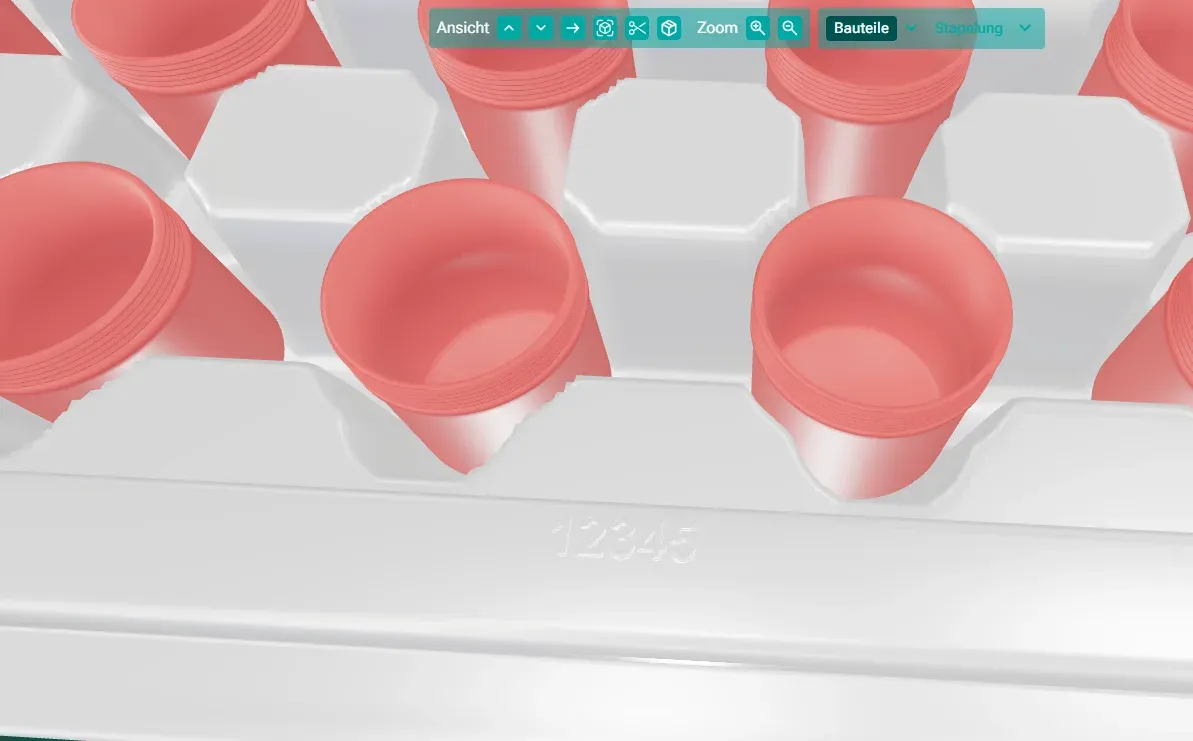
Example illustration of a number on the tray.
Barcodes and QR Codes
Machine-readable codes enable automated data capture in ERP, WMS, or MES systems. They support inventory management, order picking, and process control.
Logos and Company Markings
Company logos or brand marks create recognition value and document ownership of reusable trays.
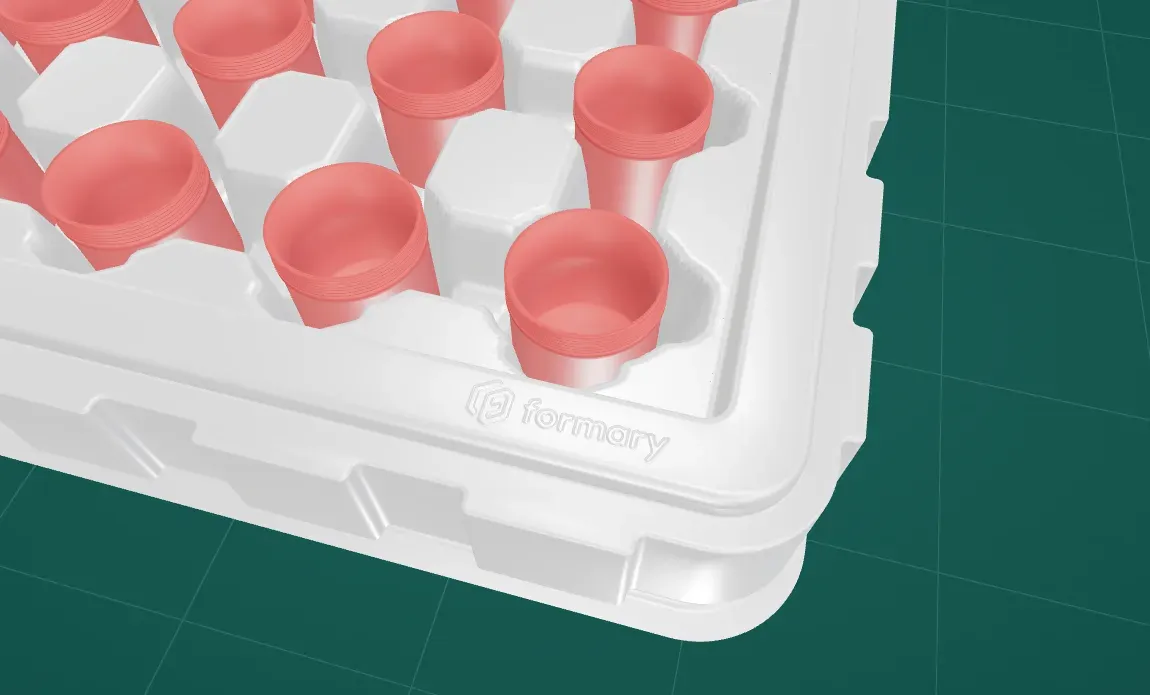
Adding logos to the tray edge.
Product Designations
Labels such as “Component A,” “Batch 2026-03,” or “ESD-protected” facilitate visual identification and reduce the risk of mix-ups.
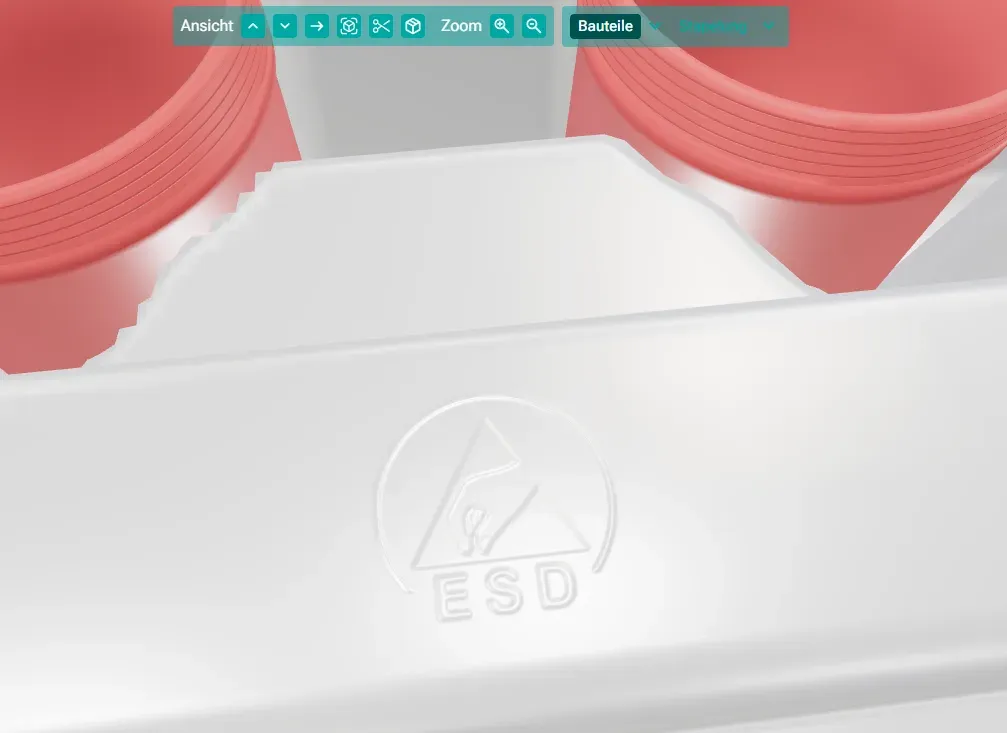
Example ESD notice on the tray.
Warning Notices
Safety notices such as “Max. stacking height 5,” “Not for food use,” or “Store in dry conditions only” can be engraved directly onto the tray.
Process Data
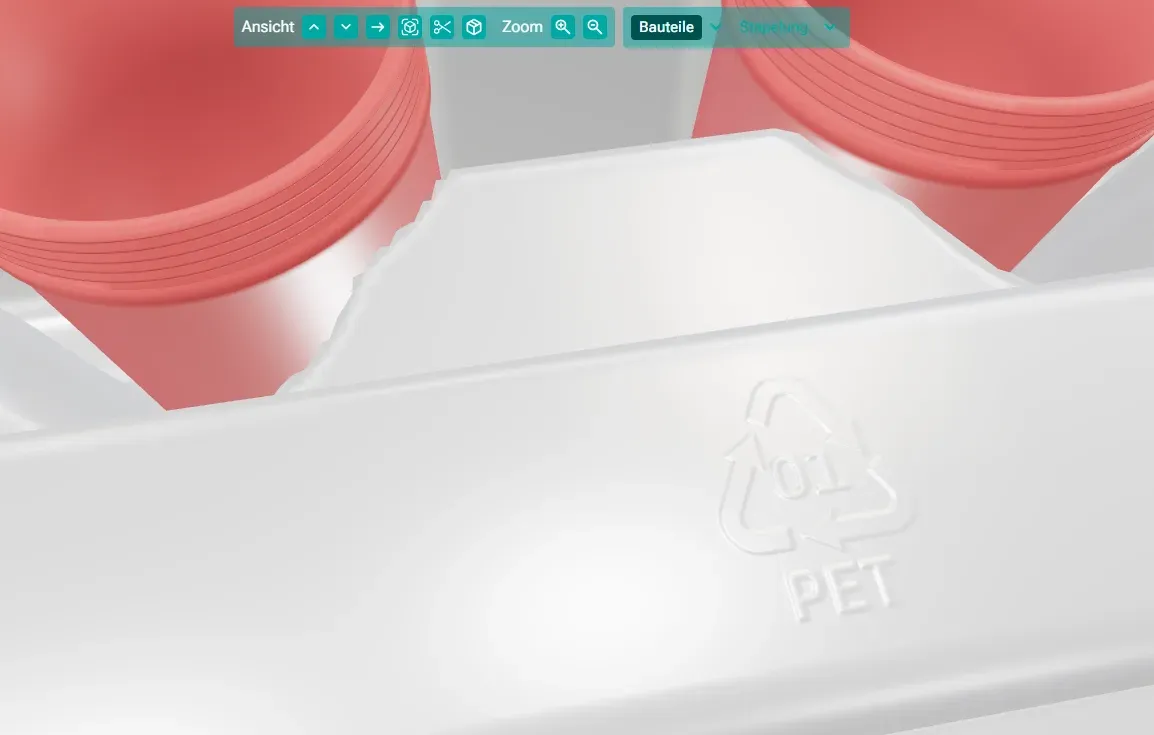
Information such as production date, material identification, or recycling codes supports quality assurance and the circular economy.
Example material identification on the tray.
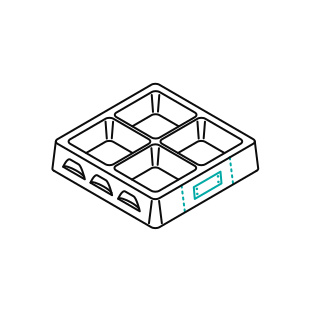
💡 The placement should be defined early in the tray design process. Areas with pronounced curvature, draft angles, or mechanical stress are less suitable. With the 3D Tray Generator, labeling areas can already be visualized during the planning phase.
How Do You Plan Tray Labeling in the Tray Design?
Tray labeling should be considered from an early stage. The reason: early planning during tray design saves costs, avoids rework, and ensures that the labeling is technically feasible and remains permanently legible.
Step 1: Define the Requirements
Before designing the tray, clarify:
What information needs to be applied?
What size does the labeling need to be?
Where should the labeling be positioned?
Will the labeling be machine-readable?
Which cleaning methods will be used?
Step 2: Consider the Geometry in the 3D Model
The 3D Tray Generator from formary makes it possible to identify suitable areas for labeling during the configuration process. Important factors include:
flat or slightly inclined surfaces for good readability
sufficiently large areas for barcodes or QR codes
accessible positions for laser, embossing, or labeling equipment
no overlap with draft angles or functional elements
Step 3: Coordinate the Method and Post-Processing
Discuss with formary which labeling method is best suited to your material, quantity, and requirements. formary coordinates the post-processing and checks technical feasibility and costs.
Step 4: Test Run and Validation
For critical applications, a test run using sample trays is worthwhile. This allows you to check readability, durability, and process integration before series production.
What Role Does Tray Labeling Play in Automation?
In automated production and logistics processes, tray labeling is important for process reliability and efficiency.
Automatic Identification
Barcodes or QR codes enable fast, error-free identification by scanners, cameras, or RFID readers. This reduces manual data entry and prevents mix-ups.
Inventory Management
Permanent markings support WMS systems in tracking trays, components, and inventory. Storage locations, movements, and inventory changes are documented automatically.
Process Control
In production lines, tray labels control assembly, inspection, or packaging processes. Correctly assigning components to the appropriate trays prevents errors and optimizes throughput times.
Traceability
Unique serial numbers enable complete traceability across production, warehousing, and supply chains. This is particularly relevant in regulated industries such as medical technology, automotive, or electronics.
Reusable Tray Management
For reusable trays, tray labeling makes it easier to manage circulating inventory, cleaning and maintenance cycles, and return logistics.
Requirements for Tray Labeling in ESD and Cleanroom Applications
ESD trays and cleanroom trays have special labeling requirements.
ESD Trays
Stickers or labels can detach and cause electrostatic charging. Engravings are permanent, do not affect conductivity, and meet ESD requirements without additional risk.
By playing the video, you agree that your data will be transmitted to YouTube and that you have read the Privacy Policy.
Cleanroom Trays
No particles or contamination may be generated in cleanrooms. Laser engraving is contactless and does not create deposits. After engraving, the tray can be cleaned and used without concern.
Medical Applications
Trays for medical applications must be sterilizable, resistant to cleaning, and traceable. Engravings meet these requirements and remain legible even after hundreds of cleaning and sterilization cycles.
💡 For ESD trays, engravings should not penetrate the conductive surface layer. Coordination with the material supplier and engraving provider ensures that the ESD properties are maintained.
Costs and Cost-Effectiveness of Tray Labeling
The unit and tooling costs involved in labeling trays depend on factors such as the method, quantity, complexity, and post-processing effort.
Laser Engraving
The one-time setup costs are low because no tooling is required. Depending on the size and complexity, the cost per unit ranges from a few cents to a few euros. For large series, the unit costs decrease significantly.
Embossing
The tooling costs for an embossing die are higher, but the unit costs are very low for large series. Embossing becomes worthwhile from quantities of several thousand trays.
Hot Stamping
Medium unit and tooling costs. Suitable for medium-sized series with high readability requirements.
Color Strips and Labels
Color strips and labels involve the lowest investment costs. They are particularly suitable for single-use applications or low quantities but do not provide permanent or alphanumeric labeling.
Cost-Effectiveness
Permanent markings such as engravings quickly pay for themselves if they eliminate manual labeling, label reordering, mix-ups, or process disruptions. Particularly for reusable trays, the investment pays off over the service life of the trays.
Common Tray Labeling Mistakes and How to Avoid Them
For tray labels to function reliably in practice, proper planning is essential. The following common mistakes should be avoided:
Mistake 1: Labeling Is Planned Too Late
If labeling is only added after the tray has been manufactured, problems with positioning, readability, or costs can arise. Plan the labeling as part of the tray design using the 3D Tray Generator.
Mistake 2: Incorrect Placement
Labels on heavily curved, mechanically stressed, or poorly accessible surfaces are difficult to read or wear quickly. Choose flat, clearly visible areas.
Mistake 3: Font Size Is Too Small
Barcodes or text that are too small cannot be reliably scanned or read. Observe the minimum requirements of the scanner systems being used.
Mistake 4: The Wrong Method Is Chosen
Not every method is suitable for every application. For example, a label applied to an ESD tray that is frequently cleaned will not remain permanently attached. Choose the method according to the material, level of stress, and intended service life.
Mistake 5: No Coordination With Automation
If trays are automatically detected, labels must be positioned at defined locations. Clarify the requirements with the automation engineering team at an early stage.
Conclusion: Using Permanent Tray Labeling Through Engraving Effectively
Well-planned tray labeling forms the basis for traceability, automation, and process reliability in plastic trays. The most suitable method depends on your project. For single-use applications, labels or color strips are often sufficient, while automated, cleanroom-related, or reusable applications benefit from permanent engravings.
The key is to take labeling into account early in the tray design process. formary’s 3D Tray Generator helps you plan suitable labeling areas, check their technical feasibility, and integrate them into production.
Tray labeling refers to the unique inscription or marking of a plastic tray, for example by means of engraving, embossing, hot stamping, color strips, or labels. It enables identification, traceability, inventory management, and automated detection in production and logistics processes.
Laser engraving creates markings by removing material or changing its color using a laser beam. It is precise, flexible, and suitable for small to medium-sized series. Embossing creates indentations through mechanical pressure and is more cost-effective for large series, but requires tooling and offers a lower level of detail.
Permanent labeling is worthwhile when trays are cleaned frequently, exposed to high mechanical stress, require traceability over several years, or are used in automated processes that require reliable and permanent markings. For single-use applications or low quantities, labels are often sufficient.
Yes. Laser engraving in particular is ideal for barcodes, QR codes, or Data Matrix codes. Its high precision also allows small codes with a high data density. It is important that the marking is positioned on a flat surface and provides sufficient contrast for scanners.
With the 3D Tray Generator, you can define, visualize, and technically assess suitable areas for labeling during the configuration process. formary coordinates the tray design, manufacturing, and post-processing so that the appropriate labeling can be integrated directly into the production process.
Further Content
Thermoformed Parts in Practice
Warehouse Inventory: Tips & Tricks for Better Warehouse Organization and Efficiency with Trays
Warehouse inventories cost time, tie up staff, and often disrupt ongoing operations. This is especially true for small parts, serial components, or recurring components, where counting quickly becomes confusing if parts are stored loose in boxes or shelf compartments. Standard trays create a simple yet effective structure here for better warehouse organization. This article shows how trays optimize inventory counts in both the warehouse and production.
Thermoformed Parts in Practice
Tray Labeling: How to Use Labels Effectively for Your Packaging
To ensure that trays can be correctly identified and used, clear labeling is essential. Depending on the application, quantity, and process requirements, different methods can be used, such as permanent engraving or flexible labels. In this article, you will learn which tray labeling methods are available, when each method makes sense, and how labeling can already be incorporated into the tray design using formary’s 3D Tray Generator.
Thermoformed Parts in Practice
Supplier Guide for Plastic Thermoformed Parts – 10 Key Factors That Matter
Choosing the right supplier for plastic thermoformed parts is crucial for the quality, efficiency, and cost-effectiveness of your production. Our 10 tips will show you what to look for when selecting a supplier.
Platform & Features
3 Factors That Accelerate Your Procurement with formary
The three key factors—time, speed, and efficiency—are crucial for success in industrial manufacturing, from inquiry to delivery. That’s why formary has optimized this process, significantly accelerating the procurement of plastic thermoformed parts. Learn more in this article.
Thermoformed Parts in Practice
Rapid Prototyping in Thermoforming – Definition, Benefits & Processes
Rapid prototyping is used in product development to quickly create preliminary models. In thermoforming, rapid prototyping offers numerous advantages for producing high-quality prototypes efficiently and cost-effectively.
Platform & Features
Project Planning in Thermoforming – From Concept to Mass Production
From the initial idea to mass production, various factors must be considered in thermoforming project planning, including material selection, tool manufacturing, and quality control. This article provides a detailed look at how a thermoforming project with formary is executed.
Thermoformed Parts in Practice
Thermoforming vs. 3D Printing – Advantages, Disadvantages, Differences, and Similarities
Plastic parts are manufactured using various processing methods. In this article, we focus on comparing the processes of plastic thermoforming and 3D printing.
Thermoformed Parts in Practice
Injection Molding vs. Plastic Thermoforming – Advantages, Disadvantages, Differences, and Similarities
In the world of plastic processing, there are various common manufacturing methods used to produce precise plastic components for industrial applications. We compare two of them: Injection Molding and Plastic Thermoforming.
Thermoformed Parts in Practice
Checking CAD Models for Thermoformability: The Designer's Guide
Whether a plastic part is thermoformable is determined in the CAD model. Anyone who discusses geometry, wall thicknesses, and demoldability only after the first sampling pays for this loop with tool modifications, material waste, and lost weeks in the project timeline. This can be avoided during design: with a structured check that evaluates each model along this guide and makes typical sources of error visible early on.